The Problem With Definitions
Both terms—core and stability—are vague, inconsistently defined, and often misunderstood.
The popularity of “core training” surged in the 1990s following research by Hodges & Richardson (7), who observed altered muscle activation patterns in people with low back pain. This sparked a simple narrative:
- Identify a “weak” or poorly timed muscle
- Fix it through isolated activation
- Restore spine stability
- Reduce pain and enhance performance
But this entire framework assumes the body has a correct way to recruit muscles—an idea that falls apart under scientific scrutiny.
The Body Does Not Work Through Fixed Patterns
If our tasks and environments were predictable, a fixed activation pattern might make sense. But they aren’t.
Movement—especially in sport—is variable, unpredictable, and context‑specific.
Sprinting ≠ lifting.
Landing ≠ cutting.
Training ≠ competition.
The body doesn’t rely on one ideal pattern.
Muscle recruitment is fluid, adaptive, and constantly reorganising in response to the environment.
Trying to hardwire specific activation sequences ignores how biological systems actually operate.
Pain, Protection, and Misinterpretation
Pain changes motor behaviour (19).
People with low back pain often show increased trunk muscle activation (18). This is usually a protective strategy, not enhanced stability.
This matters, because:
- More activation ≠ more stability
- More co‑contraction often signals threat, not performance
- Forcing extra activation may be unnecessary—or counterproductive
And even if we could reprogram muscle timing through isolated drills, the real‑world transfer would be extremely limited.
So What Is the “Core” Anyway?
There is no single agreed definition of the core.
Depending on the model, it may include:
- The trunk and pelvis (17)
- The trunk, hips, and knees (4)
- The pelvis and even the shoulder complex (5)
Two influential models highlight the disagreement:
Bergmark (2): divides muscles into local stabilisers vs global movers
Panjabi (13): proposes stability as an emergent system of passive structures, active tissues, and neural control
One model isolates; the other integrates.
And this difference is crucial.
Stability Is Something the Body Produces, Not Something You Train Directly
Research consistently shows that the body creates stability automatically, using task‑specific co‑activation strategies (3).
Stability is not imposed on the body through isolated exercises.
It emerges as a solution to movement problems.
When we try to override this through conscious bracing or isolated activation, we may:
- Disrupt coordination
- Reduce adaptability
- Increase injury risk
The goal should not be to “train stability”—but to challenge the system in ways that require stability to emerge.
Why Core Stability Tests Don’t Predict Performance
If we can’t define core stability clearly, testing it is equally problematic.
Common assessments include:
- Double leg lowering
- Plank variations
- Back extension holds
These tests measure isolated endurance, usually in static, low‑context conditions.
Athletic performance is dynamic, high‑context, and problem‑rich.
It’s no surprise research finds weak or no correlation between these tests and actual performance metrics like sprinting, jumping, or agility (8, 11, 12, 14, 15, 16).
They’re measuring different things entirely.
Does Core Training Work? It Depends What You Mean
Core training typically falls into three categories, each with limitations:
1. Isometric Exercises (Planks, Holds)
- Low‑intensity
- Context‑specific
- Limited loading capacity (10)
- Poor transfer to dynamic movement
They improve endurance—but only in the very narrow context in which they’re trained.
2. Motor Control / Rehab Exercises
Useful in early rehab when pain alters movement. But sport requires:
- External focus
- Rapid adaptation
- Reactive, not pre‑planned, coordination
Early learning naturally involves more co‑contraction that reduces with skill (9).
You cannot pre‑program this.
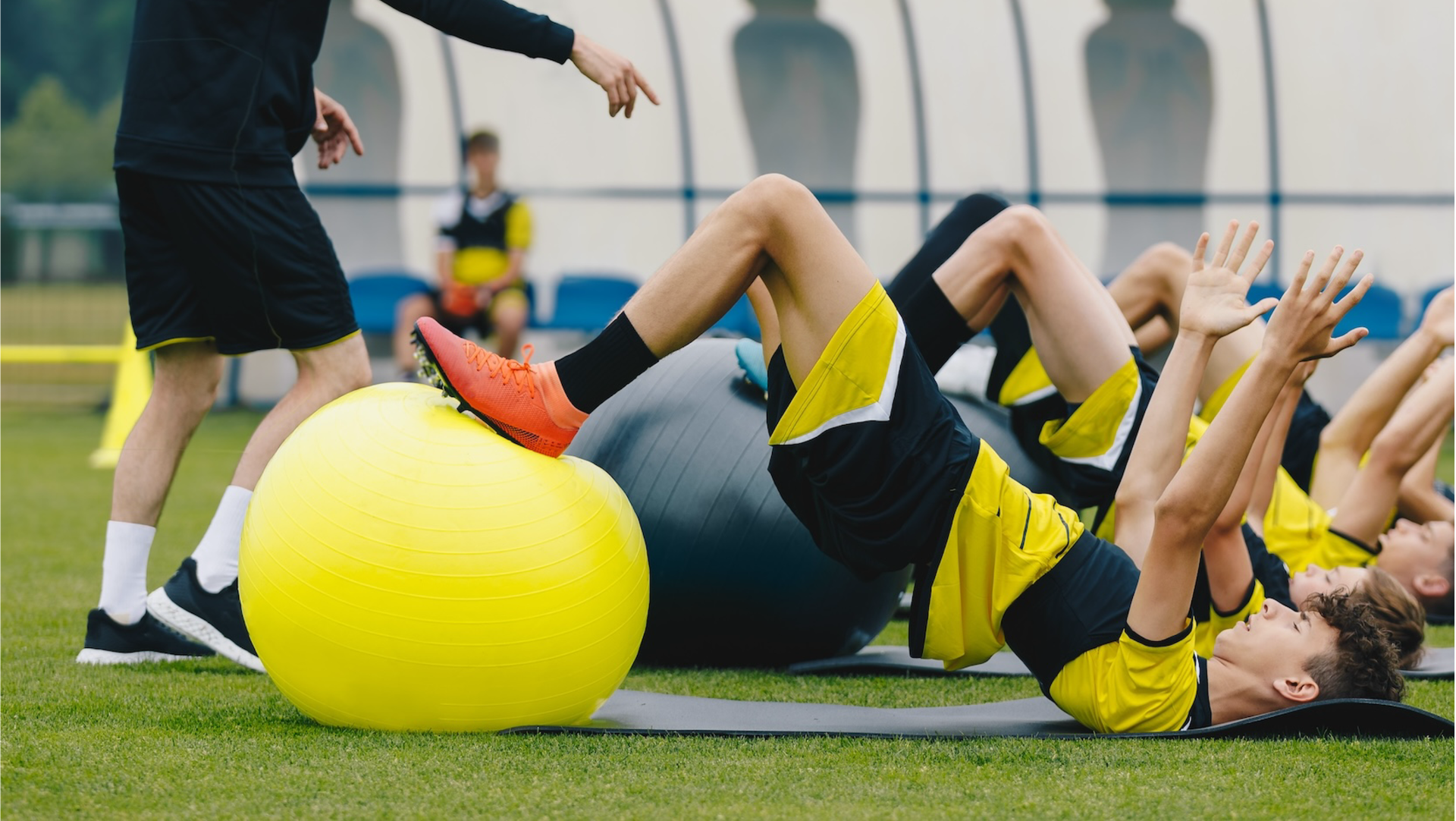
3. Unstable Surface Training
Can enhance sensory feedback and neural responses (6).
Great for youth athletes and exploration.
But:
- It reduces force production (1)
- Lower force = weaker strength stimulus
- This limits long‑term value.
Where Effective Stability Training Really Comes From
Traditional strength movements—squats, deadlifts, lunges, rows, presses—offer what isolated core exercises cannot:
Meaningful, progressive loading
High contextual relevance
Whole‑body coordination demands
Variability in speed, load, and environment
These movements don’t teach stability—they require it.
The body responds by:
- Creating the co‑activation strategies needed
- Reducing unnecessary stiffness
- Improving efficiency
- Developing robust, adaptable movement patterns
This is not micromanagement.
This is emergence.
Summary
The idea of core stability is appealing but poorly defined.
Research shows:
There is no universal definition of “core” or “stability.”
Muscle recruitment is not fixed or programmable.
Stability is context‑dependent, emerging from the interaction of body–task–environment.
Common core tests have little relationship to athletic performance.
Isolated core training offers limited real‑world transfer.
Long‑term development depends on meaningful, variable loading—not micromanaged activation.
You don’t train the core to create stability.
You expose the system to problems—and stability emerges as the solution.
References
Behm, D.G., Muehlbauer, T., Kibele, A., & Granacher, U. (2015). Effects of strength training using unstable surfaces on strength, power, and balance performance across the lifespan: a systematic review and meta-analysis. Sports Medicine, 45, 1645 – 1669.
-
Bergmark, A. (1989). Stability of the lumbar spine: a study in mechanical engineering. Acta Orthop Scand Supp, 230 – 51 – 54.
-
Brown, S.H., Vera-Garcia, F.J., & McGill, S.M. (2006). Effects of abdominal muscle coactivation on the externally preloaded trunk: variations in motor control and its effect on spine stability. Spine, 31(13), 387 – 393.
-
Fig, G. (2005). Strength training for swimmers: Training the core. National Strength & Conditioning Association, 27(2), 40 – 42.
-
Gracovetsky S, Farfan HF. & Lamy C. (1981). The mechanism of the lumbar spine. Spine, 6(3):249-262.
-
Gruber, M., & Gollhofer, A. (2004). Impact of sensorimotor training on the rate of force development and neural activation. European Journal of Applied Physiology, 92, 98 – 105.
-
Hodges, P., & Richardson, C. (1996). Inefficient muscular stabilization of the lumbar spine associated with low back pain: a motor control evaluation of transversus abdominis. Spine, 21(22), 2640 – 2650.
-
Hoshikawa, Y., Iida T., Muramatsu, M., Il, N, Nakajima, Y., Chumank, K., & Kanehisa, H. (2013). Effects of stabilisation training on trunk muscularity and physical performances in youth soccer players. Journal of Strength & Conditioning, 27(11), 3142 – 3149.
-
Lay, B.S., Sparrow, W.A., Hughes, K.M., & O’Dwyer, N.J. (2002). Practice effects on coordination and control, metabolic energy expenditure, and muscle activation. Human Movement Science, 21(5-6), 807 – 830.
-
Lum, D., & Barbosa, T.M. (2019). Brief review: effects of isometric strength training on strength and dynamic performance. Internal Journal of Sports Medicine, 40(6), 363 – 375.
-
Nesser, T.W., Huxel, K.C., Tincher, J.L., & Okada, T. (2008). The relationship between core stability and performance in division 1 football players. Journal of Strength & Conditioning, 22(6), 1750 – 1754.
-
Okada, T.M., Huxel, K.C., & Nesser, T.W. (2011). Relationship between core stability, functional movement, and performance. Journal of Strength & Conditioning, 25(1), 252 – 261.
-
Panjabi, M.M. (1992). The stabilising system if the spine. Part 1. Function, dysfunction, adaptation, and enhancement. Journal of Spinal Disorders, 5(4), 383 – 389.
-
Sharrock, C., Cropper, J., Mostad, J., Johnson, M., & Malone, T. (2011). A pilot study of core stability and athletic performance: is there a relationship? The International Journal of Sports Physical Therapy, 6(2), 63 -74.
-
Shinkle, J., Nesserm T.W., Demchak, T.J., & McMannus, D.M. (20120). Effect of core strength on the measure of power in the extremities. Journal of Strength & Conditioning, 26(2), 373 – 380.
-
Stanton, R., Reaburn, P.R., & Humphries, B. (2004). The effect of short-term Swiss ball training on core stability and running economy. Journal of Strength & Conditioning, 18(3), 522 – 528.
-
Tse, M.A., McManus, A.M., & Masters, R.S.W. (2005). Development and validation of a core endurance intervention program: implications for performance in college-age rowers. Journal of Strength & Conditioning, 19(3), 547 – 552.
-
Van Dieen, J.H., Cholewicki, J., & Radebold, A. (2003). Trunk muscle recruitment patterns in patients with low back pain enhance the stability of the lumbar spine. Spine, 28(8), 834 – 841.
-
Van Dieen, J.H., Reeves, P.N., Kawchuk, G., Van Dillen, L.R., & Hodges, P.W. (2019). Motor control changes in low back pain: divergence in presentations and mechanisms. Journal of Orthopaedic & Sports Therapy, 49(6), 370 – 379.