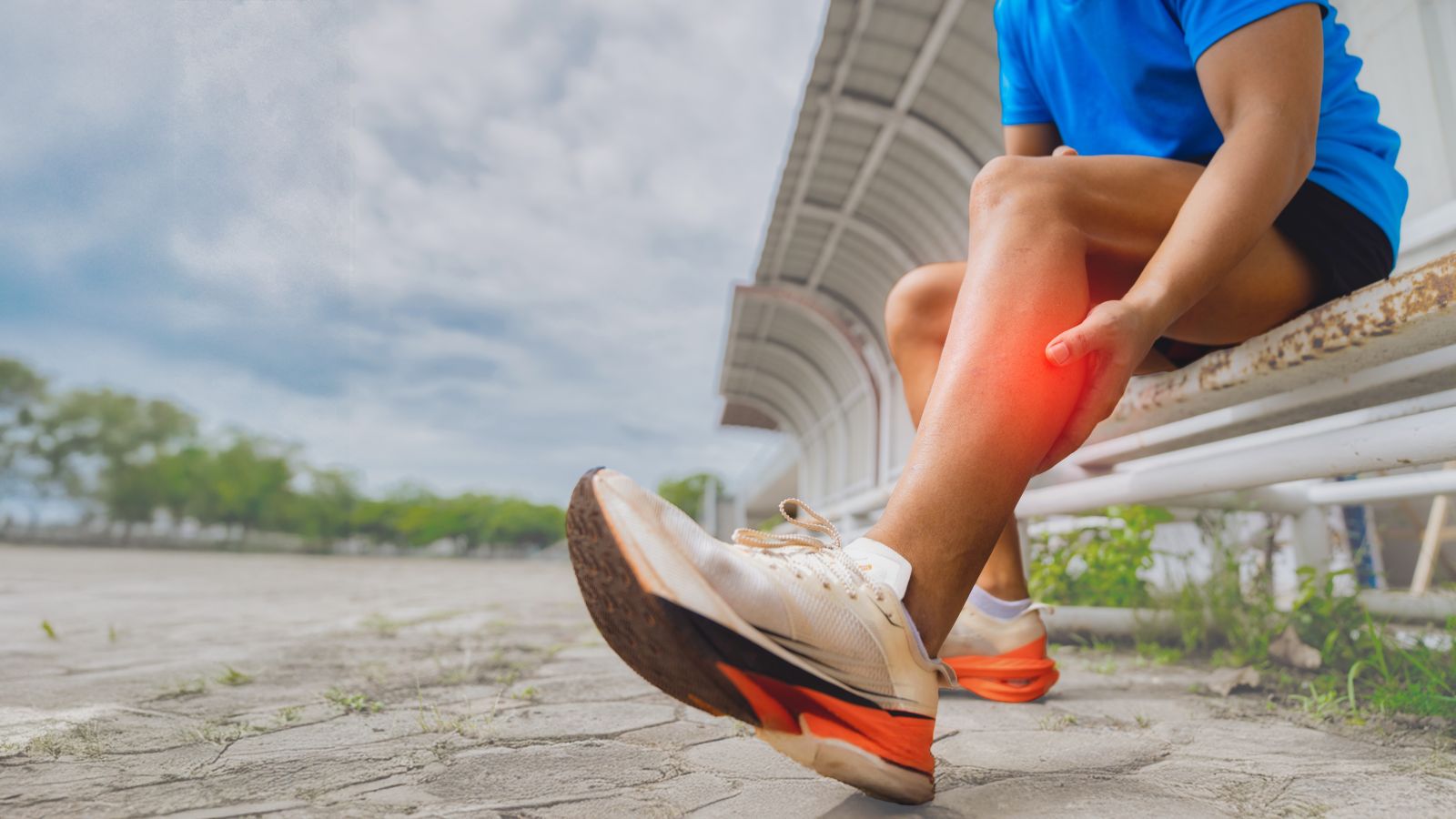
"Yet are we really doing enough to monitor the athlete — or are we merely tracking the training?"
Are We Monitoring the Athlete, or Just the Training?
Sport develops physical fitness and athletic skills, while simultaneously fostering social inclusion, leadership, communication, and teamwork (12). However, competitive environments can quickly become dominated by performance and immediate results. When that happens, the holistic development of the athlete becomes secondary.
We need to consider the athlete as an individual — encompassing their physical development, daily wellbeing, recovery status, and biological maturation — if we are to systematically reduce the risk of overuse injuries and premature dropout from sport (13, 14, 16).
The challenge is that wellbeing is not a single, monolithic metric. No single diagnostic test can determine whether an athlete is prepared to train or compete at maximal intensity. However, just as strength and conditioning coaches use a battery of physical tests to build a performance profile, simple questionnaires allow us to understand the rest of the athlete. Sleep quality, mood, fatigue, appetite, and muscle soreness all provide invaluable insights into systemic readiness (11, 15), while perceived recovery status (PRS) reveals how the body is responding to previous training stimuli (8).
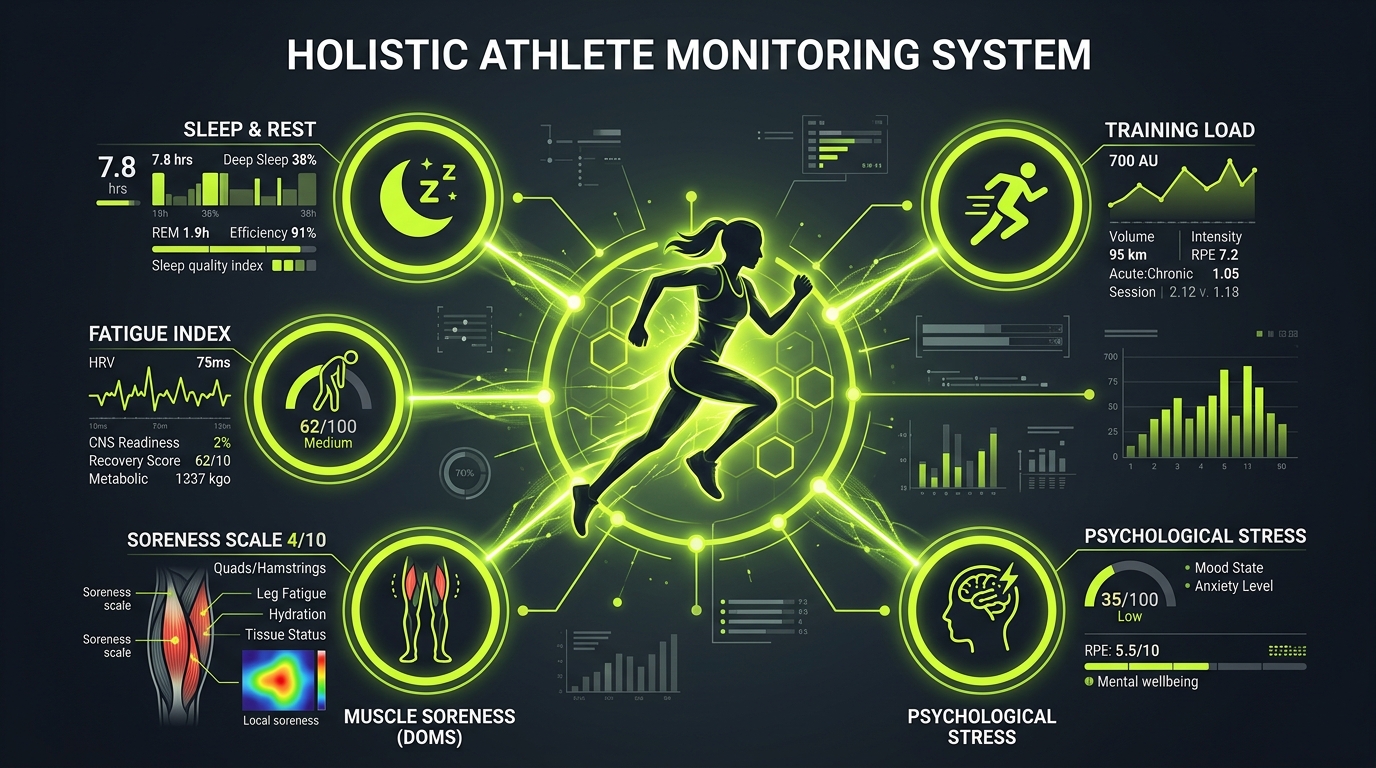
The Holistic Athlete Monitoring System: Integrating sleep, subjective fatigue, soreness, and life stress with physical training load.
Understanding Training Load in Context
Training, competition, and physical preparation all contribute to the mechanical and metabolic load placed upon an athlete. But structured training is only one piece of the puzzle. Relationships, academic studies, exams, sleep disruption, screen time, and nutrition all contribute to the overall allostatic stress an athlete experiences.
This is especially acute during adolescence, when competitive sport coincides with rapid growth spurts, hormonal fluctuations, psychological adaptations, and heightened academic demands. A lack of foundational preparation, excessive competitive volume, using the sport itself as the sole physical preparation, sudden spikes in load, and accumulating lifestyle stressors all converge to dramatically elevate injury risk (5, 12).
One landmark study of youth track and field athletes revealed that 78.6% experienced an injury, with an average time loss of approximately three weeks. Crucially, the vast majority (76%) were overuse injuries, and 17.3% of athletes retired or completely dropped out of sport before the age of 18 as a direct consequence of injury (7). The authors highlighted the urgent necessity of systematically monitoring training schedules, session intensities, and weekly cumulative volume.
We cannot understand training load without understanding the athlete experiencing it.
Tracking Wellbeing and Recovery
Modern sports technology makes capturing this data seamless. Athletes can effortlessly log loads lifted, sets and repetitions, sprint volume, distance covered, work-to-rest intervals, and session Rate of Perceived Exertion (sRPE), alongside daily subjective wellbeing metrics.
Over time, this creates something far more valuable than a detached spreadsheet of numbers: a contextual training history. It enables coaches and athletes to identify actionable patterns across load, recovery trends, and biological maturation, leading to precise calibration of training readiness.
⚡ The purpose of monitoring is never to generate more data.
The purpose is to generate better decisions.
Internal vs. External Measurements: Two Sides of Performance
A comprehensive monitoring framework relies on understanding both sides of the athletic equation:
- External measurements quantify what the athlete actually performed: sprint yardage, accelerations, decelerations, vertical jump volume, contact times, and cumulative weight lifted (3).
- Internal measurements describe how the athlete’s biological system responded: physiological indicators such as heart rate and blood lactate, paired with subjective psychological measures such as perceived exertion (1).
One of the most robust, validated, and accessible internal measures is the Rate of Perceived Exertion (RPE), captured on a 1–10 scale from very light activity to maximal effort (1). While young or developing athletes require education on self-reflection, perceptual calibration is a trainable skill. The earlier an athlete begins reflecting on how training feels, the faster they develop intuitive bodily awareness and self-regulation.
The Same Session Does Not Always Create the Same Response
Internal and external measurements are intimately linked. Imagine two athletes completing an identical strength session: same exercises, same loads, same rest intervals. Externally, the session is indistinguishable. Internally, their physiological reality may be worlds apart.
In fact, the exact same athlete will experience the identical session differently on two separate days depending on sleep duration, nutritional status, previous training density, exam anxiety, and accumulated fatigue.
The athlete is not an industrial machine delivering static output for a fixed input. They are a complex living organism whose adaptive capacity fluctuates dynamically with context.
Shift the fundamental question from:
“What training should the athlete complete?”
To the question that protects them:
“What does this athlete need today?”
Load itself is neither inherently good nor bad. Under-loading leaves an athlete fragile and underprepared for competitive demands. Conversely, unmanaged loading spikes lead to accumulated fatigue — the root common denominator uniting overtraining syndrome, immune suppression, and soft-tissue injury (4).
Understanding the Individual Athlete & Injury Vulnerability
Developing athletes face specific structural vulnerabilities, with the knees and lower lumbar spine representing the most frequently reported injury locations (9).
Furthermore, female athletes encounter significantly higher rates of anterior cruciate ligament (ACL) injury compared to their male peers. A complex web of factors contributes to this disparity, including anatomical structure (intercondylar notch width and Q-angle), cyclic hormonal fluctuations affecting ligamentous laxity, joint stiffness, and neuromuscular firing patterns during landing and cutting (6, 18).
Crucially, this does not mean every female athlete responds uniformly. On the contrary, it reinforces why cookie-cutter training fails. Athlete-reported wellbeing, daily soreness mapping, and session exertion provide coaches with an indispensable layer of individualised intelligence.
Technology Should Support the Athlete — Not Just Pile Up Numbers
Technology is only half the solution. If an athlete faithfully records their recovery every morning but the coaching staff never acts upon the data, the process is meaningless. If a coach collects GPS metrics but enforces the exact same predetermined script regardless of readiness, the data possesses zero value.
How MatchFit Pro Puts the Athlete at the Centre
This philosophy drives the Daily Readiness Check-In within MatchFit Pro: a frictionless 30-second log of sleep quality, muscular soreness, mood state, and perceived fatigue. It automatically benchmarks against the athlete’s rolling 28-day baseline, providing instant visibility to both athlete and coach — and it remains free for every athlete, forever.
Monitoring becomes transformative when it changes the conversation: the athlete gains structured space to reflect, the coach gains the context to listen, and both gain objective evidence to make intelligent training modifications.
Summary
As coaches, practitioners, and mentors, our foundational duty is to help young people become healthy first and athletes second (2). Long-term athletic development is a multi-year journey. Systematic monitoring of recovery, subjective wellbeing, and training volume provides a reliable compass.
Most importantly, it permanently shifts our focus from:
“How much training has the athlete done?”
To the question that unlocks true athletic potential:
“How is the athlete responding?”
When we truly understand the athlete, we make better decisions about their training.
MatchFit Pro is an AI-powered S&C app built with qualified S&C coaches, designed to help athletes train safely and keep improving, with parental consent built in for younger athletes. Coaches can see how it supports athlete monitoring at matchfitpro.com/coaches.
References
- Assis Manoel, F., Melo, B.P., Cruz, R., Villela, C., Alves, D.L., Da Silva, S.F., & De Oliveira, R. (2016). The utilisation of perceived exertion is valid for the determination of the training stress in young athletes. Journal of Exercise Physiology, 19(1), 27–32.
- Bergeron, M.F., Mountjoy, M., Armstrong, N., Chia, M., Cote, J., Emery, C.A., Faigenbaum, A., Hall, G., Kriemler, S., Leglise, M., Malina, R.M., Pensgaard, A.M., Sanchez, A., Soligard, T., Sundgot-Borgen, J., van Mechelen, W., Weissensteiner, J.R., & Engebretsen, L. (2015). International Olympic Committee consensus statement on youth athletic development. British Journal of Sports Medicine, 49, 843–851.
- Bourdon, P.C., Cardinale, M., Murray, A., Gastin, P., Kellmann, M., Varley, M.C., Gabbett, T.J., Coutts, A.J., Burgess, D.J., Gregson, W., & Cable, T.N. (2017). Monitoring athlete training loads: Consensus statement. International Journal of Sports Physiology & Performance, 12, 161–170.
- Gabbett, T.J. (2016). The training–injury prevention paradox; should athletes be training smarter and harder? British Journal of Sports Medicine, 50, 273–280.
- Gamble, P. (2008). Approaching physical preparation for youth team-sports players. Strength & Conditioning Journal, 30(1), 29–42.
- Huston, L.J., Greenfield, M.V.H., & Wojtys, E.M. (2000). Anterior cruciate ligament injuries in the female athlete: Potential risk factors. Clinical Orthopaedics & Related Research, 372, 50–63.
- Huxley, D., O’Conner, D., & Healy, P.A. (2013). An examination of the training profiles and injuries in elite youth track and field athletes. European Journal of Sport Science, 14(2), 185–192.
- Laurent, M.C., Green, M.J., Bishop, P.A., Sjokvist, J., Schumacker, R.E., Richardson, M.T., & Curtner-Smith, M. (2011). A practical approach to monitoring recovery: development of perceived recovery status scale. Journal of Strength & Conditioning Research, 25(3), 620–628.
- Leppänen, M., Pasanen, K., Kannus, P., Vasankari, T., Kujala, U.M., Heinonen, A., & Parkkari, J. (2017). Epidemiology of overuse injuries in youth team sports: A 3-year prospective study. International Journal of Sports Medicine, 38(11), 847–856.
- Lloyd, R.S., Cronin, J.B., Faigenbaum, A.D., Haff, G.G., Howard, R., Kraemer, W.J., Micheli, L.J., Myer, G.D., & Oliver, J.L. (2016). National strength and conditioning association position statement on long-term athletic development. Journal of Strength & Conditioning Research, 30(6), 1491–1509.
- McFarland, M., & Bird, S.P. (2014). A wellness monitoring tool for youth athletes. Journal of Australian Strength & Conditioning, 22(6), 22–26.
- Merkel, D.L. (2013). Youth sport: positive and negative impact on youth athletes. Open Access Journal of Sports Medicine, 4, 151–160.
- Paterno, M.V., Taylor-Haas, J.A., Myer, G.D., & Hewett, T.E. (2013). Prevention of overuse sports injuries in the young athlete. Orthop Clin North Am, 44(4), 553–564.
- Rejeb, A., Johnson, A., Vaeyens, R., Horobeanu, C., Farooq, A., & Witvrouw, E. (2017). Compelling overuse injury incidence in youth multisport athletes. European Journal of Sport Science, 495–502.
- Sawczuk, T., Jones, B.L., Scantlebury, S., & Till, K. (2018). Relationships between training load, sleep duration, and daily wellbeing and recovery measures in youth athletes. Pediatric Exercise Science, 30(3), 345–352.
- Stein, C.J., & Micheli, L.J. (2010). Overuse injuries in youth sports. The Physician and Sports Medicine, 38(2), 102–108.
- Stodden, D.F., Gao, Z., Goodway, J.D., & Langendorfer, S.J. (2014). Dynamic relationships between motor skill competence and health related fitness in youth. Pediatric Exercise Science, 26, 231–241.
- Toth, A.P., & Cordasco, F.A. (2001). Anterior cruciate ligament injuries in the female athlete. The Journal of Gender-Specific Medicine, 4(4), 25–34.
- Williams, C.A., Winsley, R.J., De St Croix, M.B., & Lloyd, R.S. (2017). Prevalence of non-functional overreaching in elite male and female youth academy football players. Science & Medicine in Football, 1(3), 222–228.
- Winsley, R., & Matos, N. (2011). Overtraining and elite young athletes. Medicine Sport Science, 56, 97–105.